Every week there are new stories in the Chicago media highlighting neighborhood real estate investments, announcing new development projects, or describing the ways the neighborhood residents are responding to changes in their communities.
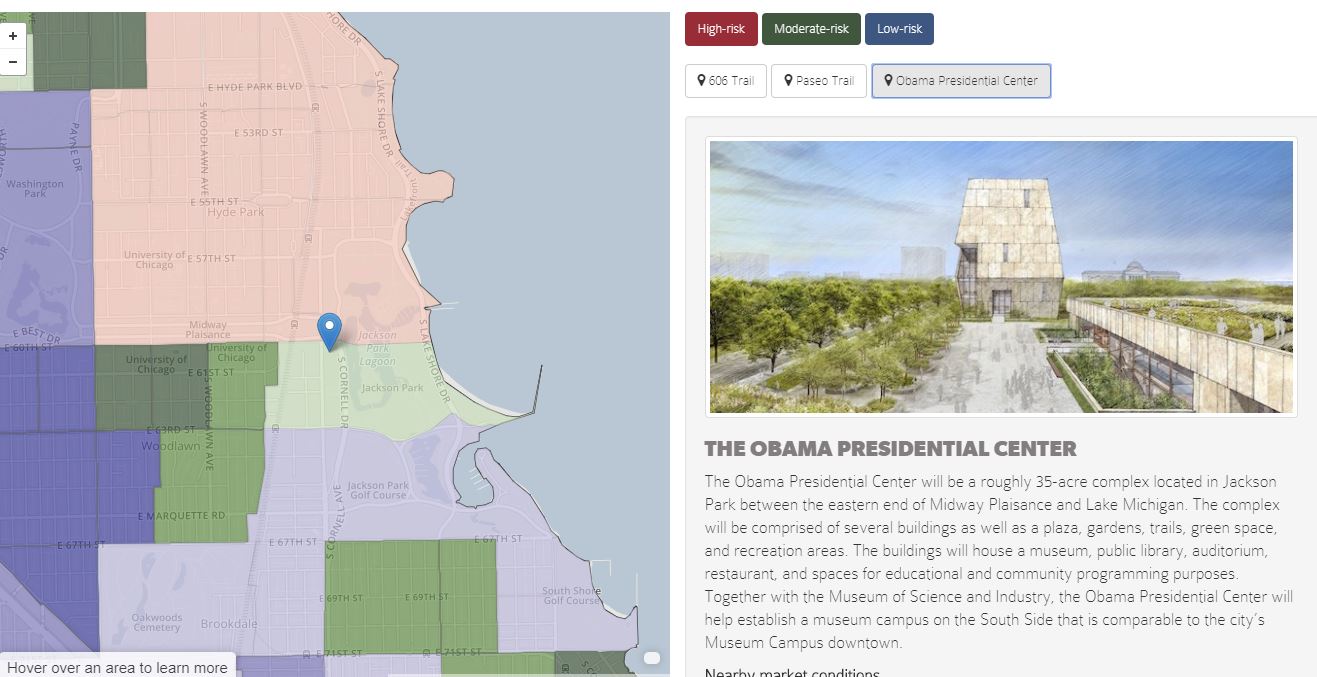
To help track these stories and put them in a market context, IHS has developed a new application of the Mapping Displacement Pressure Tool that maps the locations featured in these stories along side our neighborhood displacement pressure neighborhood typologies. Viewing these stories alongside our displacement risk indicators can provide spatial, market, and demographic context and help readers assess the potential implications of the the activies described in each article.
Explore the map tool below by clicking on each point to display the related media story and access the link to the original story. Users can click each census tract to display housing market typology informtaion. The mapping tool will be updated regularly as new media stories appear and as we update the underlying data.
UNDERSTANDING RISK LEVELS
The new tool features the displacement risk indicators which categorize neighborhood areas into three displacement risk levels:
• High-cost areas in the City where displacement is likely well underway as these areas have the highest values in the city and are experiencing higher-than-average recent increases in sales prices (red)
• Moderate-cost communities where displacement risk could be accelerated with certain projects or initiatives, especially if near transit, other existing amenities, or high-cost real estate markets. These areas are still relatively affordable but are experiencing higher-than-average recent increases in sales prices (green)
• Lower-cost areas that have seen recent market movement but still require significant investment and long-term strategies to rebuild housing demand before displacement due to rising costs becomes an issue. These areas have the lowest values in the city but are experiencing a higher-than-average recent increase in sales prices (blue)
Each market type has different drivers of demand, different current conditions, and therefore different risks associated with displacement. For high-cost areas, displacement pressure is likely coming from higher-income households and investors targeting these households, while pressure in more affordable areas is likely due to investors seeking value in potentially rising markets. For lower-cost areas, rising prices may indicate a stabilizing market or property speculation, but long-term disinvestment is likely still a central concern and driver of neighborhood change rather than
LOCAL STORIES AND CHANGING HOUSING MARKET DYNAMICS
Crain’s Chicago Business’s recent forum discusses pressures many Chicagoans are facing as a result of the lack of affordable rental units. The stories in the forum echo national trends of renters who are unable to find housing amid the continuous shrinking of the affordable housing stock. As market dynamics change and new investment occurs across Chicago’s various community areas, growing unaffordability can cause residents to face a risk of displacement.
In some neighborhoods, residents have experienced years of disinvestment, causing a lack of available housing options as buildings continue to deteriorate over time, and affordable units are not necessarily replaced as quickly as they are lost. In other areas, such as Avondale, Logan Square, Lower West Side, and Rogers Park, residents are experiencing affordability pressures as rental demands soar and development activity spikes. Planned projects such as the Obama Presidential Center and El Paseo have the potential to shift market dynamics in surrounding areas as the rental demand, and therefore prices, rise.
In line with the national and city-wide trends, many local media stories reflect these changing housing market elements and heightened pressures.
NEW DEVELOPMENTS IN RISING COST AREAS
As particular Chicago neighborhoods heat up with investment, many new developments create a ripple effect, increasing housing price pressures for nearby residents. While new rentals are needed to meet the demand in these neighborhoods, the housing costs of many new developments could further price hikes in the surrounding area, without providing affordable rentals to appease the demand.
Many residents of rising-cost areas living near these new developments are likely already cost-burdened, meaning they spend a substantial amount of their income on housing payments. The introduction of additional market-rate or luxury units signals a further rise in neighborhood rents, increasing the possibility for current residents to risk displacement as rents gradually become more unaffordable and as new developments target those earning a higher income.
Developments located in moderate-risk areas may accelerate a neighborhood’s affordability tipping point as investors target high-income renters from without, pushing values to become too expensive for current residents.
• Red Apple Buffet Closes After 30 Years in Avondale to Make Way for New Condo Building
• Pre-Leasing Begins at The Field's Lofts Near Chicago's Logan Square Neighborhood
• Uptown Elementary School-Turned Luxury Lofts A Symbol Of Neighborhood Reckoning, Gentrification
LOCATING AND UNDERSTANDING INVESTMENT ACTIVITY
Upgrades and maintenance improvements can be a natural result of new property ownership, but also has the potential to drive up rents in areas where residents already experience affordability pressure. Building modifications can result in higher values, which impacts the stock of naturally-occurring affordable housing. This is especially true for large shares of land or groups of buildings, where a rise in rents for the entire development can have a big effect on the area’s supply of affordable housing.
Media stories have also covered increased speculative investments in parts of the city that previously experienced longtime disinvestment. The “new” wave of developments in these communities illustrates the change in the market conditions across Chicago’s neighborhoods and the resulting potential rise of values that can lead to future affordability pressure.
• 11 lakefront apartment buildings hit the market in Rogers Park
• Huge South Side apartment complex to sell for $180 million
• Sterling Bay plans Englewood development
• Six-story apartment plan pitched for vacant Sheridan Road lot in Edgewater
• Big Pilsen loft building sells
• $50 Million 'Creative Office Campus' Planned For Old Lighting Warehouses In West Humboldt Park
• Could this South Shore site attract luxury buyers or renters looking for lake views?
TENANTS AND DISPLACEMENT PRESSURE
In many areas, tenants are currently feeling the effects of housing insecurities. Some residents who are cost-burdened and risk displacement from their communities have observed the increased rental demand and new investments surrounding them. Many have taken measures to protect their homes from becoming unaffordable and rejecting developments that do not provide affordable units or that they feel might push their areas to a point of displacement.
• With Their 'Backs Against The Wall', Avondale Tenants Facing Eviction Sue Management
• Albany Park renters form tenants union as family fears displacement from home of 16 years
• Jackson Park residents worry about displacement, gentrification after Obama library is built
COMMERCIAL DISPLACEMENT IN RISING COST AREAS
Small business owners often join local residents in feeling the pressures of increased property values in different community areas. Several media stories follow the closure of long-standing local shops and restaurants that can no longer afford to remain open or have consistently lost clientele as the surrounding neighborhood demographics change.
EFFORTS TO CREATE AND PRESERVE AFFORDABLE HOUSING
Amid rising housing cost pressures across Chicago’s neighborhoods, local media stories have also followed the implementation of strategies to protect affordable housing and generate new, affordable housing options in neighborhoods that are experiencing spikes in investment. (add more here)
• New plot: Almost 400 homes planned alongside 'Chicago Fire' and 'Empire' filming studio
• Developer says Obama library will help transform struggling Woodlawn
• Affordable housing developer tapped for East Garfield Park project
• Senior Veterans Are Getting An Affordable Housing Complex Near Roosevelt And Sacramento
• Pilsen Nonprofit To Unveil Design Plan For $20 Million Affordable Housing Development
• Lawndale Wins Lion's Share Of Home Improvement Grants, But Funding Runs Out Quicker Than Anticipated
• As The Paseo progresses, city strategizes to preserve nearby neighborhoods
The dynamics of Chicago’s housing market are regularly shifting, and the effects of recent trends in the market have led to affordability challenges in neighborhoods where investment and development are booming. That’s not to say that the recent activity is detrimental, but the need for policy efforts that both create and preserve affordable units cannot be overlooked as residents in the aforementioned neighborhoods continue to experience intensifying housing costs.
The stories above have documented the changes in housing prices and rental stock in several Chicago neighborhoods, potential speculative investment activity, and tenants’ experiences with their own risk and fears of being displaced.
METHOD
The media articles above have been included in this working list because they satisfy the following criteria:
• Article involves a location at a specific address or at a location that is able to be mapped.
• Subject matter relates to affordable housing creation and preservation efforts, residential property sales or investments, small business displacement, neighborhood change, development of luxury or high-cost housing, major development projects or proposals, or tenant advocacy against gentrification and displacement.
• Subject matter occurs within or adjacent to areas IHS’s displacement risk map has identified as low-risk, moderate-risk, or high-risk areas.